Project Shield & Sync: Unified Tactics for Modern Retail Flash Mob Defense
Implementing a comprehensive retail flash mob defense is critical. In an era where organized retail crime (ORC) leverages speed, numbers, and digital coordination, traditional security measures are no longer enough. Project Shield & Sync is an intensive strategic briefing designed for law enforcement leadership and retail executives.
This program moves beyond basic loss prevention to explore a synchronized, "friction-based" defense model. Participants will examine how to integrate autonomous surveillance, structural hardening, and real-time intelligence networks to transform retail environments from soft targets into high-risk, low-reward zones for criminal syndicates. By the end of this session, attendees will understand how to bridge the communication gap between the public and private sectors to dismantle flash mob operations before they reach the storefront.
To combat the evolving threat of "flash mob" organized retail crime (ORC), law enforcement (LE) and retailers must shift from a reactive mindset to a synchronized, tech-forward defense. These groups rely on speed and overwhelming numbers; your strategy must rely on friction and real-time intelligence.
Here are the top 10 strategies for blending physical hardening with advanced coordination.
1. Unified Intelligence & LPR Networks
The "flash mob" doesn't start at your front door; it starts in the parking lot.
-
Strategy: Deploy License Plate Recognition (LPR) cameras at all shopping center entrances.
-
The Tech: Systems allow LE and retailers to share "Hot Lists." If a vehicle associated with a previous "smash-and-grab" enters the perimeter, an automated alert is sent to both store security and local patrol units before the suspects even park.
2. Autonomous Drone Response (DFR)
Traditional "eye in the sky" is too slow.
-
Strategy: Implement Drone as a First Responder (DFR) programs.
-
The Tech: Modern autonomous drones can launch within seconds of a silent alarm. They provide high-resolution, bird’s-eye tracking of getaway vehicles—crucial for "no-chase" jurisdictions—and can stream live feeds directly to responding officers' smartphones.
3. Fog Security & Sensory Deterrents
If they can't see the product, they can't steal it.
-
Strategy: Install Security Fog (Smoke) Systems in high-value zones (e.g., jewelry, electronics).
-
The Tech: Upon a breach, the system fills the room with a dense, non-toxic fog in seconds, reducing visibility to less than 1 foot. This kills the "speed" advantage of a flash mob and forces them to retreat empty-handed.
4. Reinforced "Smash-Proof" Glazing
Standard tempered glass is no longer sufficient against sledgehammers.
-
Strategy: Retrofit storefronts with Polycarbonate Glazing or Security Window Film.
-
The Tech: These materials are designed to take repeated heavy impacts without shattering, buying the 2–3 minutes of "time-to-breach" necessary for LE to arrive.
5. AI-Driven Behavioral Analytics
Moving from "recording" to "predicting."
-
Strategy: Use AI-integrated CCTV to flag "anomalous behavior."
-
The Tech: Software can now detect "loitering in groups," "rapid movement toward exits," or "masked faces" in real-time. This allows security to lock down high-value cases or move staff to safety before the first display case is hit.
6. Geofenced Communication Hubs
Information silos are a flash mob’s best friend.
-
Strategy: Establish a Retail-LE Real-Time Communication Bridge.
-
The Tech: Retailers in a specific district should be on a shared, encrypted radio or data channel. When Store A sees a suspicious group, Stores B and C are alerted instantly, and LE can monitor the "digital chatter" for a coordinated response.
7. Smart Locks & Mobile Access Control
Physical keys are a liability during a high-stress event.
-
Strategy: Shift to Bluetooth Low Energy (BLE) or NFC-enabled smart locks for all high-value cases.
-
The Tech: Employees use mobile devices as keys. In an emergency, management can "Global Lock" every case in the store with one tap, preventing the rapid "clearing" of shelves.
8. RFID "Exit Gates" & Invisible Tracking
Traditional EAS (Electronic Article Surveillance) tags are easily ignored by mobs.
-
Strategy: Use UHF RFID for item-level tracking and recovery.
-
The Tech: Unlike standard tags, RFID sensors at the door can log exactly what was stolen and in what quantity. This data is instantly sent to LE to help build "Organized Crime" cases (higher felony thresholds) rather than simple shoplifting charges.
9. Hardened Entryway Architecture
The "front door" should be a bottleneck, not a gateway.
-
Strategy: Deploy Anti-Ram Bollards and Speed-Folding Security Gates.
-
The Tech: Impact-rated bollards prevent vehicles from driving through storefronts, while interior "man-trap" gates can be deployed to slow down the exit of a mob, increasing the chance of apprehension.
10. Multi-Jurisdictional Task Forces
Flash mobs are rarely local; they are regional networks.
-
Strategy: Retailers must participate in ORC Task Forces (e.g., CLEAR or local fusion centers).
-
The Tech: Use centralized platforms to upload "Digital Evidence Packages" (video, LPR data, suspect photos) that link a crime in one city to five others, allowing prosecutors to dismantle the entire "fence" (resale) network rather than just the "boosters" (thieves).
Learning Pillars
I. Hardening the Perimeter: Multi-Layered Deterrence
-
Focus: Physical defense and mechanical friction.
-
Outcome: Master the integration of advanced glazing, high-impact barriers, and sensory disruptors to maximize "time-to-breach" and neutralize the speed advantage of flash mob tactics.
II. Proactive Detection: Operationalizing Real-Time Intelligence
-
Focus: Predictive analytics and perimeter identification.
-
Outcome: Establish a robust framework using License Plate Recognition (LPR) and AI-driven behavioral analytics to flag "Hot List" vehicles and anomalous group movements before a breach occurs.
III. Persistent Oversight: Autonomous Aerial Surveillance
-
Focus: Maintaining visual custody and evidence gathering.
-
Outcome: Evaluate and deploy Drone-as-a-First-Responder (DFR) programs to track suspects safely in "no-chase" environments, ensuring high-fidelity evidence collection for later apprehension.
IV. Unified Response: Synchronized Inter-Agency Communications
-
Focus: Bridging the gap between Law Enforcement and Retailers.
-
Outcome: Develop encrypted, geofenced communication protocols that allow for the instant sharing of "digital chatter" and real-time situational awareness across public and private sectors.
V. Strategic Prosecution: Leveraging Digital Evidence
-
Focus: Investigative depth and dismantling criminal networks.
-
Outcome: Utilize item-level RFID tracking and regional data-sharing platforms to elevate simple theft reports into complex organized crime cases, targeting the broader resale hierarchy and "fencing" operations.
60-Second Flash Mob Tactical Checklist
This tactical checklist is designed for the immediate 60-second window of a flash mob event. The goal is to move from a state of surprise to a state of controlled defense and data capture.
Phase 1: 0–15 Seconds — Initial Detection & Alert
-
[ ] Trigger the "Silent Bridge": Immediately activate the silent panic alarm or the store’s designated mobile alert app (e.g., Zello, BeOn) to notify Law Enforcement and regional security.
-
[ ] Identify the Threat Level: Confirm if the group is armed or strictly utilizing "smash-and-grab" tools (hammers, bats).
-
[ ] Announce "Code [Store Name]": Use a pre-set overhead code (e.g., "Assistance needed in Aisle 4") to alert staff to move to safety without inciting further panic among customers.
Phase 2: 15–30 Seconds — Physical & Visual Lockdown
-
[ ] Global Case Lockdown: If equipped with smart-lock technology (e.g., InVue/Sennco), trigger the "Global Lock" on all high-value electronics and jewelry cases.
-
[ ] Initiate Smoke/Fog Deterrents: If the system is manual, deploy the security fog (Protect Global/Density) to obscure high-value zones.
-
[ ] Safe-Zone Redirection: Verbally and physically direct customers and non-essential staff toward rear exits or secure "safe rooms" (stockrooms).
Phase 3: 30–45 Seconds — Intelligence Gathering
-
[ ] Activate "Drone-on-Alarm": If the store utilizes a DFR (Drone as a First Responder) system, verify it has launched to begin tracking the perimeter and getaway vehicles.
-
[ ] Verbal "Non-Engagement": Ensure no staff members attempt to physically block the mob. Instruct them to stay back and observe identifying features (clothing brands, tattoos, heights).
-
[ ] Secure the Digital Record: If possible, "Bookmark" the CCTV feed on the manager’s tablet to ensure the initial entry point is preserved for LE investigators.
Phase 4: 45–60 Seconds — Perimeter & Exit Observation
-
[ ] Monitor the Getaway: From a safe distance, observe the direction of flight. Use the LPR (License Plate Recognition) dashboard if accessible to confirm if any "Hot List" vehicles were triggered.
-
[ ] Establish "Hot Mic" with LE: Stay on the shared communication bridge. Provide real-time updates: "Suspects exiting North doors toward black SUV, partial plate [Numbers]."
-
[ ] Post-Event Freeze: Once the mob exits, immediately cordone off the area to preserve forensic evidence (blood, dropped tools, or items for DNA markers).
Pro-Tip for Managers: Your primary job is Information Flow. The products are tagged with RFID; the suspects are on camera. Your only "win" in these 60 seconds is keeping your people safe while feeding high-quality data to responding officers. Contact us to learn more about our retail flash mob defense programs.
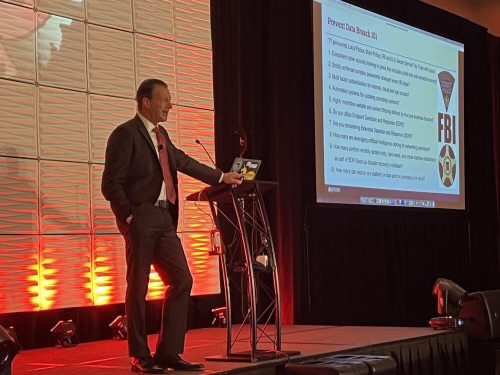


Why Meeting Planners Choose Project Shield & Sync: Unified Tactics for Modern Retail Flash Mob Defense
In an era where "flash mob" organized retail crime (ORC) dominates the headlines and destabilizes local economies, meeting planners are under pressure to provide high-stakes, actionable content. Project Shield & Sync is the premier choice for law enforcement conferences and retail leadership summits because it replaces "check-the-box" security with a sophisticated, friction-based defense model.
Planners choose this program for three distinct reasons:
1. The Expert Pedigree
Led by Robert Siciliano, a 30-year security veteran and #1 Best Selling Amazon author, this program brings unparalleled credibility. As the Architect of the Strategic Human Firewall™, Siciliano bridges the "Security Appreciation Gap," transforming complex law enforcement tactics into relatable, "kitchen table" strategies that resonate with both store managers and police chiefs.
2. A Future-Proof Tech Stack
While other programs focus on basic loss prevention, Project Shield & Sync dives into the 2026 tech landscape. It provides deep-dive insights into Drone-as-a-First-Responder (DFR), AI-driven behavioral analytics, and smoke-deterrent systems. Planners value the inclusion of specific, vetted vendors, ensuring attendees walk away with a roadmap for implementation, not just a list of theories.
3. Synchronized Public-Private Partnerships
The program’s core strength lies in its Unified Roman Numerical Pillars. It teaches retailers and law enforcement how to speak the same digital language—using geofenced communication hubs and LPR networks to dismantle criminal syndicates. This collaborative approach turns a disjointed response into a synchronized net.
For the meeting planner, Project Shield & Sync is more than a keynote; it is a tactical briefing that addresses the most urgent threat in modern commerce. It delivers the "Strategic Human Firewall" necessary to protect people, profits, and public safety.
In-Person or Online: Uncompromised Engagement
Humans learn through interaction, not just observation. We understand that effective learning requires active participation, not passive listening. That’s why our in-person training is built on high-impact dialogue, not monologues. We engage the room immediately, turning your team into active participants rather than passive attendees. That is why every one of our live programs is a dialogue from the very beginning.
We don’t just lecture; we interact, challenging the audience with questions and providing real-time answers.
However, we understand that modern budgets and complex schedules often demand virtual solutions. We promise that our online training is never a compromise. We deliver the same level of intensity and interaction virtually, ensuring that the Strategic Human Firewall™ is built effectively, regardless of the medium.

Online Cyber Security Training
Our most affordable option provides a video library where you choose when and what you want employees to learn.
Cyber Security Seminars for Employees
Online or in-person. One day or multi-day. Our seminars, led by Cyber Security Expert Robert Siciliano, can be customized to your specific employee and organizational needs. All seminars include in-depth question-and-answer sessions to reinforce learning.
What Are Your Employee Training Needs?
Unsure where to begin? Speak to an employee training specialist about Retail Flash Mob Defense, at Protect Now. We will help you assess your needs and find a training program that fits your employees and budget.
These are the specific phrases meeting planners and directors of education use when searching for a training curriculum:
-
"ORC Task Force Training" (Organized Retail Crime is the industry standard).
-
"De-escalation and Resistance Training" (Focusing on staff safety during swarms).
-
"Multi-Jurisdictional Crime Coordination" (For LE audiences looking to link cases).
-
"Friction-Based Retail Defense" (For slowing down thieves).
-
"Digital Fencing Suppression" (Focusing on where stolen goods are sold, e.g., online marketplaces).

Meeting Planner & Director of Education FAQ
Q: We’ve seen standard "Loss Prevention" talks before; how is this program different?
A: Most retail security programs are reactive and siloed. Project Shield & Sync is a proactive, synchronized offensive. Robert Siciliano moves beyond "locking the doors" to architecting a Strategic Human Firewall™. We don't just discuss theft; we teach Law Enforcement and Retailers how to merge their tech stacks—using LPR, DFR, and AI—to create a unified net that makes flash mob tactics mathematically high-risk and low-reward.
Q: Can this program be customized for specific audiences, like small boutique owners vs. urban police departments?
A: Yes. Whether you are a Director of Education for a National Retail Federation chapter or a Training Officer for a Major City Chiefs association, the content is tailored to your specific friction points. We adjust the "Learning Pillars" to focus more on Tactical Response for LE or Physical Hardening and Tech Integration for retailers, ensuring the "Security Appreciation Gap" is closed for every stakeholder in the room.
Q: Our schedule is tight; is this a "scare-tactic" presentation about rising crime or actionable education?
A: Robert shatters the mold of fear-based lecturing. While he exposes the evolving speed of organized retail crime (ORC), he provides a clear, empowering framework through his Five Roman Numerical Pillars. Attendees don't leave feeling overwhelmed by the news cycle; they leave with a 60-Second Tactical Checklist and a vetted vendor list to begin hardening their perimeters immediately.
Q: How does this session support our internal Security Directors and District Managers?
A: Robert acts as the ultimate force multiplier for your internal security team. By moving security from "check-the-box" compliance to the "Kitchen Table," he fosters a culture where employees at every level—from the loading dock to the C-suite—understand their role as a sophisticated detection layer. He makes the Security Director's job easier by turning passive staff into active participants in the store's defense.
Q: Is the content updated for the latest 2026 technological developments?
A: Absolutely. This program is specifically built for the "Tech-Forward Defense" era. We cover the transition from passive CCTV to autonomous Drone-as-a-First-Responder (DFR), AI-driven behavioral analytics, and forensic DNA tagging. We ensure your audience is prepared for the exact "swarming" tactics and digital coordination used by modern syndicates right now.